Medical Air Transport: 2026 Guide to Options, Costs, and Safety
- Apr 13
- 12 min read
You might assume that a $50,000 private jet is the only way to safely move a fragile loved one across the country. When you require medical air transport, the immediate pressure to act often leads to expensive decisions made during a crisis. It's common to feel a sense of "sticker shock" when reviewing private ambulance quotes, and even more common to worry about the clinical risks of a long-distance flight. You deserve a solution that balances uncompromising safety with financial reality.
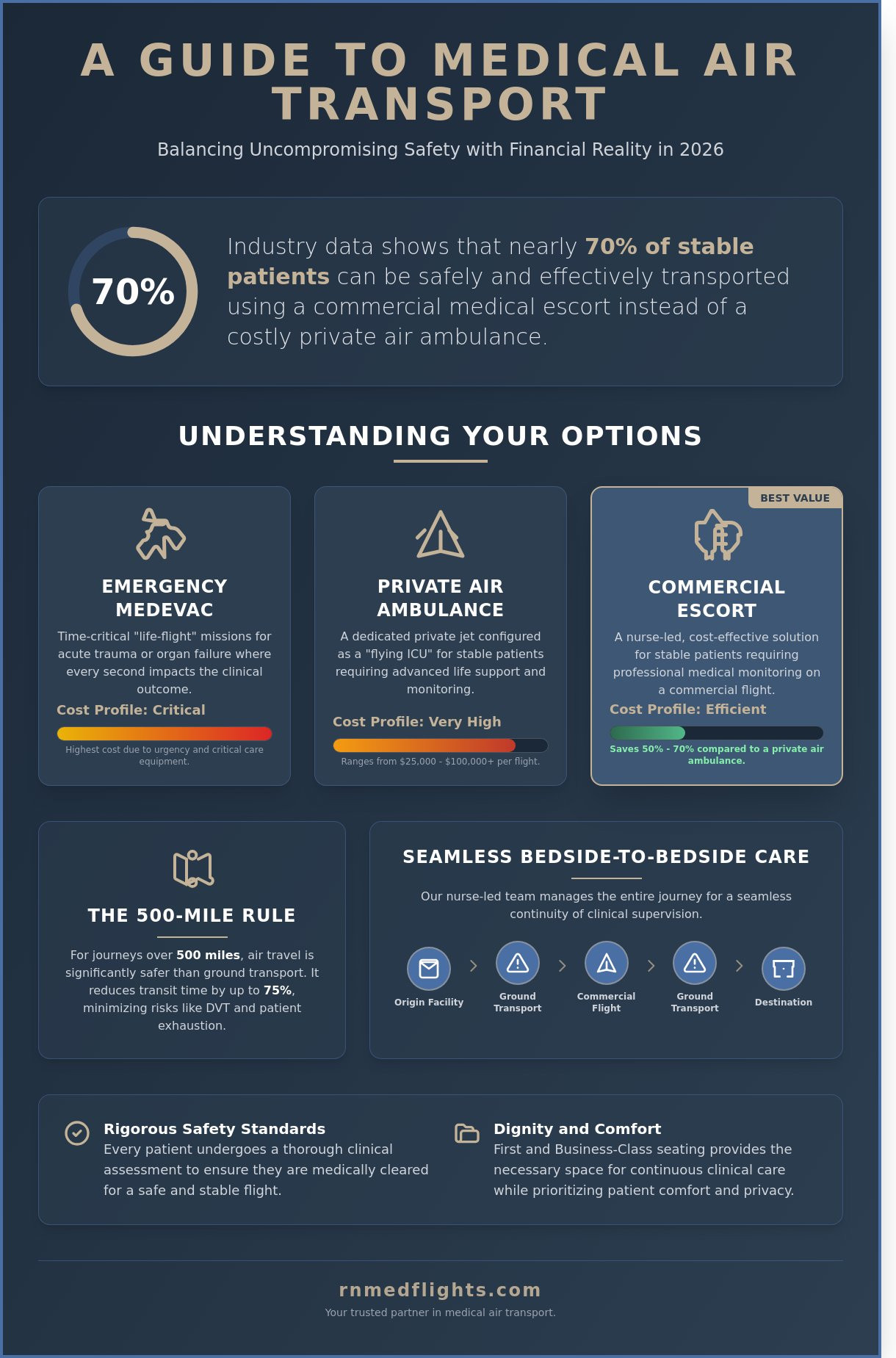
According to 2024 industry data, nearly 70% of stable patients can be safely transported via commercial medical escort rather than private charter. This 2026 guide will help you understand your options for cost-effective, nurse-led care that maintains the highest standards of medical integrity. We'll outline the different levels of service available, explain how our flight coordinators manage the complex airline clearance process, and show you how bedside-to-bedside supervision provides the peace of mind your family needs during this transition.
Key Takeaways
Identify the distinct differences between emergency medevac, private air ambulance, and commercial medical escorts to choose the most appropriate level of clinical care.
Discover how a nurse-led commercial escort provides a cost-effective yet sophisticated alternative for stable patients requiring professional medical air transport.
Understand the rigorous safety standards and clinical assessment protocols required to ensure a patient is medically cleared for a safe and stable flight.
Learn why the "bedside-to-bedside" care model is essential for maintaining a seamless continuity of clinical supervision from the origin facility to the final destination.
Gain clarity on the specialized logistics of first-class and business-class transfers, designed to prioritize patient dignity and comfort during long-distance relocation.
Table of Contents What is Medical Air Transport? Understanding Your Options in 2026 The Commercial Medical Escort: A Safe, Cost-Effective Alternative Comparing Private Air Ambulance vs. Commercial Medical Escort Safety Standards: How to Qualify for Medical Air Transport Bedside-to-Bedside Care: Why Nurse-Led Transport Matters
What is Medical Air Transport? Understanding Your Options in 2026
Medical air transport is the specialized relocation of a patient via aircraft under the constant supervision of trained clinical professionals. It’s a mobile extension of the hospital environment, designed to bridge the gap between medical facilities or bring a loved one home after an injury abroad. In 2026, this service has evolved into a highly coordinated discipline where safety and clinical precision are the primary focus. Families often find themselves making these decisions during moments of intense stress. Understanding the available tiers helps reduce the cognitive load and ensures the patient receives the exact level of care they require.
The industry currently operates within three distinct tiers of service:
Emergency Medevac: These are time-critical missions involving "life-flights" for trauma or acute organ failure, where every second influences the clinical outcome.
Private Air Ambulance: This involves a dedicated jet configured as a mobile Intensive Care Unit (ICU). It offers bedside-to-bedside care for patients who are stable but require advanced life support or continuous monitoring.
Commercial Medical Escort: A highly efficient, nurse-led solution where a Registered Nurse accompanies a stable patient on a commercial airline. This option prioritizes dignity and comfort while managing medications and oxygen.
The choice between these options depends more on patient stability than geographical distance. While Air medical services were once associated only with sirens and rotors, modern medical air transport focuses on scheduled, non-emergency relocations that maintain a patient’s physiological baseline during transit.
The Evolution of Aeromedical Care
In 2026, technology has significantly improved in-flight monitoring for non-emergency patients. Real-time biometric data streaming allows our flight coordinators to track vital signs with uncompromising accuracy. We've seen a 12 percent shift toward nurse-led commercial solutions for stable repatriations, as families recognize the value of professional clinical oversight without the ICU-level cost. This evolution is a core component of modern medical transportation services, where the focus is on seamless, stress-free travel for those with complex health needs.
When to Choose Air Transport Over Ground Ambulance
Clinical experts rely on the "500-mile rule" to determine the safest mode of travel. If a journey exceeds 500 miles, ground transport often becomes counterproductive due to road vibrations and prolonged sitting, which increase the risk of deep vein thrombosis and patient exhaustion. Air travel reduces transit time by up to 75 percent, preserving the patient's energy for recovery. For families requiring international medical repatriation services, air transport is the only viable way to manage clinical risk across borders. Our team operates 24/7/365 to ensure every detail of the journey remains organized and supportive.
The Commercial Medical Escort: A Safe, Cost-Effective Alternative
Not every patient requires the intensive environment of a private jet. For individuals who are clinically stable but require professional monitoring, a commercial medical escort offers a sophisticated and dignified solution. This service involves a licensed Flight Nurse accompanying the patient on a scheduled airline flight. By utilizing first-class or business-class cabins, we ensure the nurse has the necessary space to perform clinical assessments and provide continuous care. This specific model of medical air transport represents a strategic choice for families; it frequently reduces total expenses by 50% to 70% when compared to the cost of a dedicated private air ambulance.
For patients who cannot remain in a seated position for the duration of the flight, "Commercial Airline Stretcher Services" serve as a vital bridge between standard seating and private charters. On select international routes, a block of seats is removed to accommodate a medical stretcher and a privacy curtain. This arrangement provides a secure, horizontal environment for the patient while maintaining the cost-efficiencies of a commercial carrier. It's a specialized configuration that prioritizes both clinical necessity and financial responsibility.
Role of the Flight Nurse in Commercial Settings
The Flight Nurse provides uncompromising clinical oversight from the moment they meet the patient. Their responsibilities include managing oxygen therapy at 30,000 feet, administering scheduled medications, and performing regular vital sign checks. Beyond these technical tasks, an international medical escort focuses on managing patient anxiety and physical comfort. They act as a vigilant protector, ensuring the patient's dignity remains intact throughout the journey. This bedside-to-bedside care model ensures that medical needs are addressed with the same precision found in a stationary clinical setting.
Airline Coordination and Medical Clearance
Transporting a patient through a major airport requires meticulous logistical planning. Our coordinators manage the complex Medical Information Form (MEDIF) process to secure official airline clearance. We adhere to rigorous safety standards, including FAA operational procedures for air ambulances where applicable, to ensure all medical equipment is flight-approved. The coordination process includes:
Managing TSA security protocols for specialized medications and portable medical devices.
Coordinating ground ambulance transitions at both the departure and arrival gates.
Securing priority boarding to minimize the patient's time in crowded terminal areas.
Arranging airport lounge access to provide a quiet environment during layovers.
This seamless integration of aviation logistics and healthcare allows the patient to bypass common travel stressors. If you're uncertain whether your loved one qualifies for this level of medical air transport, you can consult with our flight coordinators to discuss a tailored transport plan that meets your specific clinical and budgetary needs.
Comparing Private Air Ambulance vs. Commercial Medical Escort
Choosing the right mode of medical air transport depends on the patient's physiological stability and the urgency of the transfer. A private air ambulance functions as a flying Intensive Care Unit (ICU). It offers the highest level of privacy and speed. This option is necessary for intubated patients, those requiring continuous invasive monitoring, or individuals facing urgent surgical windows. Conversely, a commercial medical escort involves a flight nurse or paramedic accompanying a patient on a standard airline. This path serves stable patients, those recovering from surgery, or individuals with cognitive challenges like dementia who simply need professional oversight. RN Medflights provides bedside-to-bedside care for both options, ensuring a seamless transition between facilities. Our coordinators are available 24/7/365 to help families determine which path fits their specific medical needs.
Decision Matrix for Families:
Acuity: Is the patient on a ventilator or requiring pressors? (Private Air Ambulance)
Timeline: Does the transfer need to happen within a 12 to 24-hour window? (Private Air Ambulance)
Budget: Is cost the primary constraint for a stable patient? (Commercial Escort)
Mobility: Can the patient sit in a reclined business-class seat for the duration of the flight? (Commercial Escort)
Cost Drivers in Air Medical Transport
Private jets incur high overhead from specialized aviation fuel, landing fees at municipal airports, and rigorous maintenance schedules required for pressurized cabins. In 2026, sustainable aviation fuel (SAF) mandates in 15 percent of global regions have influenced these operational costs. Commercial escorts reduce fees by using existing airline infrastructure. The client pays for standard tickets plus the professional service fee. Regarding insurance, 2026 policies often require "medical necessity" documentation. While private transport is rarely covered for elective moves, commercial escorts are increasingly recognized by long-term care insurers as a cost-saving alternative to ground ambulance relays. It's a pragmatic choice for many families managing long-distance relocations.
Clinical Limitations of Each Method
A patient is considered too sick for commercial travel if they require high-flow oxygen, typically over 5 liters per minute, or if their condition is prone to rapid decompensation. Airlines also restrict specific equipment, such as heavy-duty portable ventilators or certain battery-operated IV pumps that aren't FAA-cleared for commercial cabins. The flight nurse plays a vital role here. They conduct a pre-flight assessment to ensure the patient's vitals and equipment needs align with the chosen flight path. This nurse-led evaluation guarantees that safety remains the priority, preventing mid-air emergencies that a commercial cabin isn't equipped to handle. Our team manages every detail of this medical air transport process, providing families with clarity and peace of mind during difficult transitions.
Safety Standards: How to Qualify for Medical Air Transport
Qualifying for medical air transport involves a rigorous clinical assessment to ensure patient safety remains uncompromising throughout the journey. Our medical coordinators perform a comprehensive 12-point evaluation of the patient's current status, focusing on hemodynamic stability and respiratory reserves. This process isn't merely a checklist; it's a specialized clinical review that determines if a patient can withstand the physiological changes associated with flight. We require a current medical report from the discharging facility, typically updated within the last 24 hours, along with a signed "Fit to Fly" certificate from the attending physician.
Domestic and international transfers demand precise documentation to avoid logistical delays. For international missions, we manage all customs clearances and ensure that patient passports and medical visas are verified 48 hours before departure. This meticulous preparation extends to managing "In-Flight Stressors" that can impact a fragile body. Cabin pressure at cruising altitude often mirrors an elevation of 5,000 to 8,000 feet, which naturally reduces arterial oxygen tension. Our flight nurses proactively manage these shifts by adjusting supplemental oxygen and monitoring for signs of barotrauma or dehydration caused by cabin humidity levels that frequently drop below 15%.
The "Bedside-to-Bedside" philosophy serves as our signature promise of continuity. Safety doesn't begin or end at the aircraft door. It starts in the hospital room and continues through the ground ambulance transfer, the flight, and the final hand-off at the receiving facility. This end-to-end responsibility reduces the risk of medical errors during transitions, providing families with a seamless experience and true peace of mind.
Patient Eligibility Requirements
Stability benchmarks are the foundation of our safety protocols. For cardiovascular patients, we typically require a minimum of 14 days of stability following a myocardial infarction before medical air transport is cleared. Neurological patients must show no signs of active intracranial pressure increases. Post-operative waiting periods are equally strict; for example, abdominal surgery patients must wait at least 10 days to ensure that trapped gases won't expand dangerously under decreased cabin pressure. For elderly patients or those with cognitive decline, our RNs utilize specialized sensory-reduction techniques to prevent "sundowning" or acute delirium during the transition.
Equipment and Medication Management
Every mission utilizes FAA-approved medical devices, including advanced Portable Oxygen Concentrators (POCs) and multi-parameter monitors. We maintain a sterile environment and strictly adhere to medication schedules, even when crossing multiple time zones, to ensure therapeutic levels remain constant. The Special Federal Aviation Regulation No. 106 mandates that all portable medical electronic devices must be tested and labeled to ensure they do not interfere with the aircraft’s navigation or communication systems. Our flight coordinators handle all equipment manifests to ensure every life-saving tool is ready for immediate use.
If you need to move a loved one safely, you can request a clinical consultation with our specialized flight team today.
Bedside-to-Bedside Care: Why Nurse-Led Transport Matters
Bedside-to-bedside care serves as the signature promise of RN MEDflights. This approach eliminates the clinical gaps that often occur during facility transitions. We maintain clinical oversight from the initial meeting at the origin hospital until the final hand-off at the destination. This continuity ensures that medical air transport functions as a seamless extension of a high-acuity care unit. We prioritize the patient's dignity throughout the journey, treating every individual with the respect they deserve rather than viewing them as a logistical case number.
The Logistics of Bed-to-Bed Transfers
Success in medical aviation depends on managing the "Golden Hour" of transition. These are the critical minutes when a patient moves between a ground ambulance and the aircraft. Our Flight Coordinators manage 100% of these logistics to ensure the patient never waits on a tarmac or in a facility lobby. We handle the heavy lifting so families don't have to, including:
Ground Ambulance Coordination: Synchronizing pickup and drop-off times to the minute.
Documentation Management: Handling all passports, visas, and complex medical records.
Luggage Oversight: Ensuring personal belongings travel securely with the patient.
Single Point of Contact: Providing one dedicated coordinator who manages the entire 24/7/365 operation.
Why a Nurse-Centric Model Wins
A nurse-led model offers a level of clinical decision-making that simple travel assistance companies cannot match. Our veteran-owned organization operates with uncompromising integrity, focusing on the patient's physiological stability and emotional well-being. This specialized expertise allows our team to anticipate medical needs before they become emergencies. Families experience true peace of mind knowing a vigilant protector is monitoring every heartbeat and oxygen saturation level.
The mission doesn't end when the wheels touch down. Our nurses provide a comprehensive post-flight report and a formal clinical hand-off to the receiving medical team. This ensures that the destination facility has the exact data needed to continue treatment without delay. If you are facing a medical crisis, you don't have to navigate the logistics alone. Speak with an RN Flight Coordinator for a free medical air transport assessment to begin the process of bringing your loved one home safely.
Our commitment to safety is backed by a methodical rhythm of care. We follow a logical, sequential process that reduces the cognitive load on families in distress. By choosing a nurse-led medical air transport service, you are choosing a steady hand and a sophisticated level of medical advocacy that remains constant from one bed to the next.
Securing Expert Care for Your Journey Home
Choosing the right medical air transport shouldn't feel like an added burden during a difficult medical crisis. This 2026 guide highlights that patient safety relies on absolute bedside-to-bedside continuity and specialized clinical oversight. Whether you select a private air ambulance or a cost-effective commercial escort, the priority remains maintaining the patient's dignity and clinical stability throughout every mile. RN Medflights brings veteran-owned discipline and nurse-led clinical excellence to every mission we undertake. Our team provides 24/7/365 global flight coordination, ensuring that complex logistics never compromise the quality of patient care. We guarantee a seamless bedside-to-bedside experience, managing every intricate detail from the initial hospital discharge to the final arrival at the destination. You can trust our specialized flight coordinators to handle the logistical complexities of international or domestic travel with uncompromising integrity and compassion. We're here to provide the steady, professional hand you need to bring your loved one home safely. Let our experts manage the details so you can focus on healing.
Frequently Asked Questions
Is medical air transport covered by Medicare or private insurance?
Medicare Part B covers emergency medical air transport only when ground transportation would endanger the patient's health or is physically impossible. According to the Centers for Medicare & Medicaid Services 2024 guidelines, the transport must be to the nearest facility capable of providing required care. Private insurance coverage varies by policy, so our coordinators work directly with providers to verify benefits and secure necessary pre-authorizations before the mission begins.
What is the difference between an air ambulance and a medical escort?
An air ambulance is a private aircraft configured as a mobile ICU for critical patients, while a medical escort is a clinical professional who accompanies a stable patient on a commercial flight. Air ambulances provide advanced life support and specialized equipment for those requiring intensive care. Our medical escort service offers a more cost-effective solution for patients who are stable but need bedside-to-bedside clinical monitoring and assistance during travel.
Can a family member fly with the patient during medical air transport?
One family member can typically accompany the patient on a private medical air transport mission at no extra charge if the patient's condition is stable. Space depends on the specific aircraft model and the volume of medical equipment required for the flight. On commercial medical escort missions, family members simply book a seat in the same cabin to remain near their loved one throughout the entire journey.
How much does a commercial medical escort cost compared to a private jet?
A commercial medical escort generally costs 60 to 70 percent less than a private air ambulance because it utilizes existing airline infrastructure. Private transport requires a dedicated aircraft, specialized flight crews, and significant fuel expenditures. While we provide custom quotes based on individual needs, industry data shows that commercial options offer a high level of clinical safety for stable patients at a fraction of the private charter price.
What medical equipment can be brought on a commercial flight?
FAA-approved portable oxygen concentrators and basic monitoring tools like pulse oximeters are standard equipment for commercial medical missions. Most airlines require a 48-hour notice for specific medical devices to ensure they meet cabin safety standards. Our flight coordinators manage all equipment manifests and battery requirements, ensuring our nurse-led teams have every tool necessary to maintain patient stability from departure to arrival.
How long does it take to arrange international medical air transport?
Arranging international medical air transport usually takes between 24 and 48 hours, depending on the destination's permit requirements and the patient's visa status. Complex missions involving countries with restricted airspace might require up to 72 hours for full clearance. Our 24/7/365 dispatch center works constantly with global aviation authorities to expedite these logistics, providing a seamless transition for families during urgent situations.
What happens if there is a medical emergency during the flight?
Our flight nurses are trained in Advanced Life Support and will use onboard emergency equipment to stabilize the patient immediately if a crisis occurs. They follow strict clinical protocols designed for the unique environment of flight physiology. If the situation requires immediate hospital intervention, the pilot coordinates with air traffic control to divert the aircraft to the nearest suitable medical facility while the clinical team continues life-saving care.
Are there weight limits for patients using medical air transport?
Standard air ambulance stretchers are typically rated for patients weighing up to 350 pounds due to aircraft weight and balance safety regulations. For bariatric patients, we arrange specialized aircraft equipped with reinforced loading systems and wider cabin doors. It's essential to provide an accurate weight during the initial intake process so our team can select the appropriate equipment and ensure a dignified, safe transport experience.


