


TSA Carry-On Rules 2026: The Essential Guide for Medical Travelers
- 2 minutes ago
- 12 min read
Imagine standing at a busy security checkpoint with a life-sustaining infusion pump, wondering if the current tsa carry on rules will jeopardize your vital equipment. For many of the 2.9 million passengers flying daily, security is a minor inconvenience, but for a medical traveler, it's a high-stakes environment where confusion can lead to confiscated supplies. You likely feel that the standard airport experience wasn't designed for your specific health needs. The physical strain of the queue and the fear of a TSA agent mishandling your specialized devices are valid concerns that weigh heavily on any patient or caregiver.
We're here to provide the clinical clarity you need to travel with absolute peace of mind. This guide ensures you maintain your dignity and safety by mastering the 2026 regulations tailored for medical necessity. You'll discover exactly how to bypass liquid limits for medications, secure exemptions for advanced life support devices, and utilize the TSA Cares program to eliminate the stress of the screening process. By following these nurse-vetted steps, you can transform a complex logistical hurdle into a predictable and manageable journey.
Key Takeaways
Master the standard 2026 tsa carry on rules and size dimensions to ensure your medical essentials meet security requirements without unnecessary delays.
Identify specific medical exemptions for liquids and gels that allow you to bypass standard quantity limits when properly declared to security officers.
Implement the "Ready-Access" packing strategy to keep critical medications organized and visible, facilitating a more dignified and efficient screening process.
Understand your rights regarding private screenings and learn how to request a Passenger Support Specialist for personalized assistance at the checkpoint.
Discover how bedside-to-bedside flight nurse coordination removes the burden of security logistics, providing uncompromising peace of mind for your entire journey.
Table of Contents Standard TSA Carry-On Rules: The 3-1-1 Liquid Rule and Size Limits Medical Exemptions: What TSA Allows Beyond the 3-1-1 Rule Preparing Your Medical Carry-On: Documentation and Packing Strategies Navigating the Security Checkpoint with Disabilities or Medical Needs How RN MEDflights Simplifies TSA Compliance for Medical Travel
Standard TSA Carry-On Rules: The 3-1-1 Liquid Rule and Size Limits
The Transportation Security Administration oversees the protocols that keep our skies safe. For families coordinating medical travel, understanding the current tsa carry on rules is vital for a seamless transition from ground to air. These regulations aren't meant to be obstacles; they're designed to balance high-level aviation security with the need for steady passenger throughput. By 2026, the agency has refined the distinction between prohibited items, which are never allowed, and restricted items, which may require specific documentation or specialized packing. Maintaining clinical precision in your preparations ensures that your focus remains on the patient's well-being rather than logistical delays at the checkpoint.
The 3-1-1 Rule for Liquids, Aerosols, and Gels
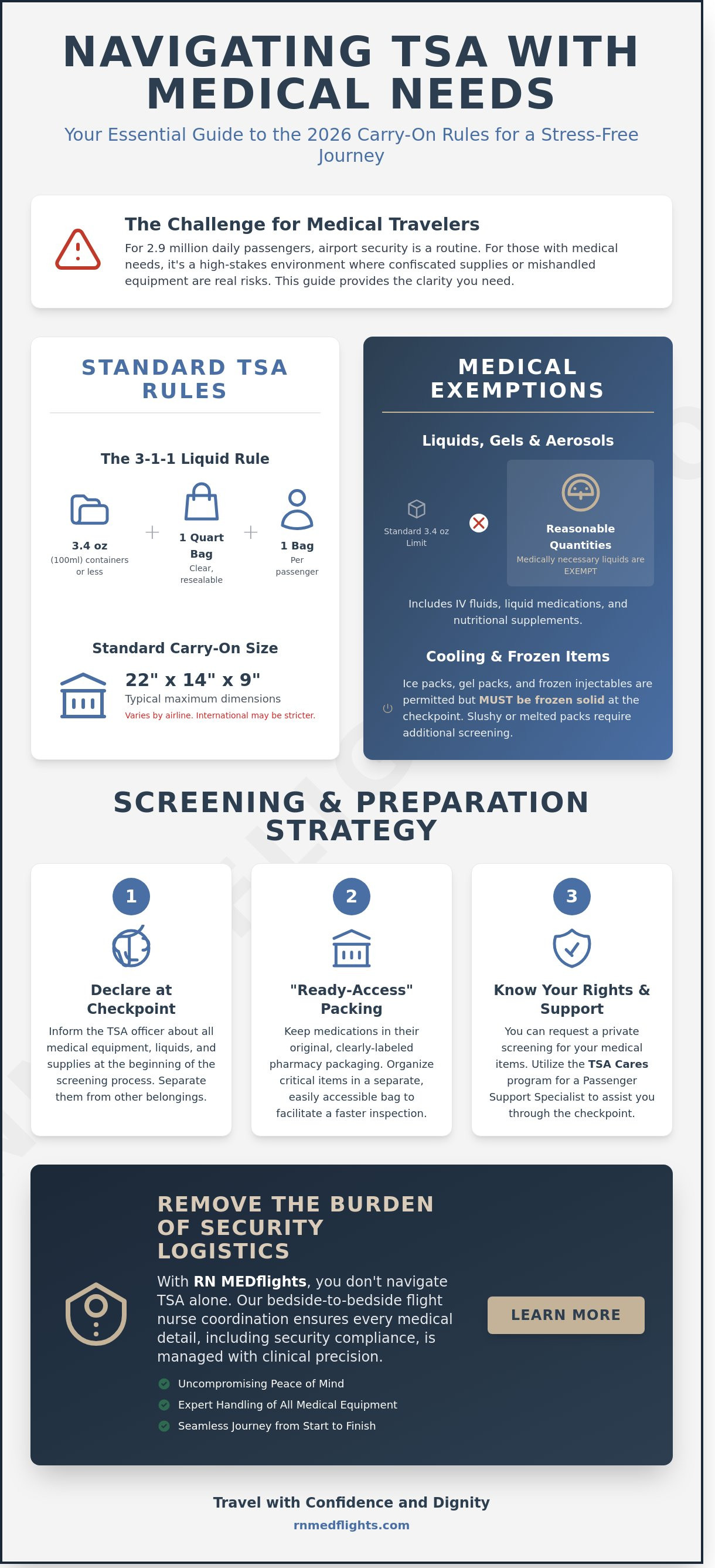
The 3-1-1 rule remains the standard for most travelers. Every liquid, aerosol, or gel must be in a container that is 3.4 ounces (100 milliliters) or less. All these containers must fit into a single, clear, quart-sized, resealable plastic bag. Each passenger is limited to one such bag. Common toiletries like toothpaste, hair gels, and medicinal aerosols must fit these parameters to pass through standard screening. There's a specific exception for duty-free liquids purchased during international travel. These items are permitted in carry-on bags even if they exceed 3.4 ounces, provided they're packed in a secure, tamper-evident bag and the original receipt is visible. For medical travelers, this rule often requires careful decanting of non-essential hygiene products to save space for critical supplies.
Carry-On Size and Weight Restrictions for 2026
Airlines maintain strict control over cabin space to ensure safety and comfort. The typical dimensions for a carry-on bag in 2026 are 22 x 14 x 9 inches, including handles and wheels. However, airline-specific variations occur frequently. Domestic carriers in the United States often allow these standard dimensions, but international carriers may be more restrictive. Weight limits vary significantly between international and domestic travel. While most US domestic carriers don't strictly weigh carry-on bags, many international airlines impose a limit of 7 to 10 kilograms (15 to 22 pounds). This limit is particularly relevant for those transporting medical cargo or specialized monitoring equipment. We recommend consulting our carry on size guide for a detailed breakdown of airline dimensions. Planning your luggage according to these tsa carry on rules provides the peace of mind necessary for a dignified and stress-free journey.
Medical Exemptions: What TSA Allows Beyond the 3-1-1 Rule
Standard tsa carry on rules limit liquids to 3.4 ounces or 100 milliliters per container. However, medical travelers operate under a different set of protocols designed to protect patient health. Medically necessary liquids, gels, and aerosols are exempt from these volume restrictions. This exemption covers a broad range of items, including IV fluids, liquid medications, and specialized nutritional supplements required for chronic conditions. You don't have to fit these items into a single quart-sized bag.
You must inform the TSA officer about your medically necessary liquids at the beginning of the screening process. This transparency allows the officer to handle your supplies with the specialized care they require. Expect the officer to conduct additional screening on these exempt items. This often involves a physical inspection or a vapor trace test to ensure safety. Frozen injectables require specific cooling methods. Use ice packs or gel packs, but ensure they are frozen solid when you reach the checkpoint. If these packs show signs of melting or contain standing liquid, they may trigger more intensive inspection protocols.
Liquid Medications, IV Fluids, and Nutritional Supplements
Patients requiring larger volumes of saline or liquid prescriptions can travel with confidence. TSA allows these items in reasonable quantities for your flight. We recommend keeping all medications in their original pharmacy packaging. Clear, professional labeling accelerates the screening process and maintains the integrity of the prescription. This rule also protects pediatric patients. TSA permits breast milk, formula, and juice for infants or patients with specific metabolic needs in quantities exceeding 3.4 ounces. For a comprehensive list of allowed medical items, consult TSA's official 'What Can I Bring?' list to prepare for your 2026 travels.
Portable Oxygen Concentrators (POCs) and Medical Devices
Understanding the distinction between tsa carry on rules and FAA regulations is vital for respiratory patients. While TSA screens the device for security, the FAA determines if a POC is safe for in-flight use. Your device must be FAA-approved to operate during the journey. Screening protocols for CPAP machines, nebulizers, and insulin pumps are routine but thorough. You should remove your CPAP from its carrying case and place it in a bin, though the mask and tubing can stay in the bag. Always carry extra batteries. Most airlines require you to have 150% of your flight time in battery life to account for unexpected delays. Our flight coordinators manage these complex logistics 24/7/365 to ensure your bedside-to-bedside transition remains seamless and stress-free.
Preparing Your Medical Carry-On: Documentation and Packing Strategies
Professional organization acts as the primary safeguard against the stress of airport security. When you manage complex health needs, your luggage isn't just a suitcase; it's a mobile care unit. Understanding the 2026 tsa carry on rules requires more than just reading a list of banned items. It demands a systematic approach to how those items are presented to officers. We recommend the Ready-Access packing method, which involves placing all life-sustaining equipment and medications at the very top of your bag in a single, removable layer. This prevents the need for officers to rummage through your personal belongings, maintaining the sterile integrity of your medical supplies.
Separation is equally vital for a seamless transition through the checkpoint. You should keep your medical liquids, gels, and aerosols in a dedicated, clear bag separate from your standard 3.4-ounce toiletries. While the TSA allows larger volumes of medically necessary liquids, keeping them distinct prevents confusion and speeds up the manual inspection process. To maintain clinical order, create a Medical Travel Portfolio. This should be a physical binder and a mirrored digital file on a secure device containing your prescriptions, insurance details, and emergency contact numbers. This level of preparation reflects the uncompromising standards we maintain in bedside-to-bedside care.
Essential Medical Documentation for the Security Checkpoint
Your physician’s letter is your most powerful advocacy tool. It must be printed on official letterhead, ideally dated within 30 days of your flight, and specifically list your diagnosis alongside every piece of required equipment. You should also utilize the TSA Notification Card. This card allows you to discreetly inform officers of your condition without announcing it to the entire terminal. For those traveling abroad, ensuring your us passport renewal online is finalized at least 8 weeks before departure is a critical step in your logistics chain. Always review TSA's guidelines for travelers with disabilities and medical conditions to stay updated on the latest 2026 screening protocols. Properly documenting your supplies ensures you remain compliant with tsa carry on rules while protecting your dignity.
Packing Techniques for Quick Security Access
Clear, labeled packing cubes are the gold standard for medical travel. Use one cube for respiratory supplies, another for IV kits, and a third for daily medications. This modular approach allows for rapid identification during a search. If you carry delicate diagnostic tools, request a manual visual inspection to protect sensitive sensors from potential X-ray interference. When your itinerary includes a non emergency ambulance service for ground transport at your destination, pack a 24-hour backup supply of medications in your carry-on. This buffer accounts for unexpected traffic or weather delays during the transfer. Our flight coordinators always emphasize this redundancy to ensure patient safety remains constant from the moment you leave home until you reach your final destination.
Navigating the Security Checkpoint with Disabilities or Medical Needs
The transition from a medical vehicle to the airport gate requires meticulous planning and a calm, methodical approach. You shouldn't feel overwhelmed by the complexity of the screening process. TSA provides dedicated resources to ensure the dignity of every patient remains intact while maintaining safety standards. Understanding your rights and the available support systems is the first step toward a stress-free journey.
Utilizing TSA Cares and Passenger Support Specialists
Contact the TSA Cares helpline at 1-855-787-2227 at least 72 hours before your scheduled departure. This specific timeframe allows the agency to coordinate with local airport leadership to assign a Passenger Support Specialist (PSS) to your checkpoint. A PSS acts as a dedicated liaison, ensuring that tsa carry on rules regarding medical liquids, internal devices, and life-support equipment are applied correctly and with empathy. These specialists are trained in disability etiquette and can help navigate the logistics of the security line. If your journey involves emergency medical transportation, the PSS will work in tandem with your flight coordinator to facilitate a seamless handoff from the ground medical team to the terminal environment.
Special Screening Procedures for Non-Ambulatory Patients
Passengers who utilize wheelchairs or commercial airline stretcher services follow specialized protocols. If a patient cannot stand for the Advanced Imaging Technology scanner, TSA officers will perform a pat-down while the patient remains seated or reclined. You always have the right to request a private screening room if the patient feels more comfortable in a secluded setting. We recommend having a medical professional present during this time to assist with patient positioning and to monitor vital signs. Our nurse-led teams prioritize bedside-to-bedside care, meaning an RN is available to explain clinical equipment to TSA staff, ensuring that tsa carry on rules are followed without compromising the patient's medical stability.
Communicating with officers is vital when a patient is non-verbal or cognitively impaired. Use a TSA Notification Card or a formal letter from a physician to describe the patient's condition and any triggers they might have. This proactive step reduces the need for verbal explanations in a high-sensory environment. It also ensures the screening is conducted with the necessary clinical precision and compassion. Our team is available 24/7/365 to help you prepare these documents and manage every logistical detail of the trip.
Speak with an RN Medflights coordinator today to ensure your loved one receives the expert care and protection they deserve during air travel.
How RN MEDflights Simplifies TSA Compliance for Medical Travel
Managing a medical crisis is overwhelming; navigating an airport shouldn't add to that burden. RN MEDflights provides a specialized solution by placing a licensed flight nurse at the center of your travel logistics. This clinical expert doesn't just monitor vital signs. They act as a professional liaison between the patient and security officials. By having a medical professional manage every interaction, families can step back from the technicalities and focus on their loved one's recovery. Our team understands that tsa carry on rules are not just guidelines but strict protocols that require precise communication to navigate without delays.
We eliminate the uncertainty that often leads to gate-side stress. Our flight coordinators begin work at least 72 hours before the scheduled departure, contacting airlines and TSA leadership to flag the upcoming transport. This proactive communication ensures that every piece of life-sustaining equipment is pre-approved for the cabin. We take full responsibility for the regulatory hurdles, ensuring a seamless transition through the terminal. Our goal is to provide a steady hand in a storm, offering a sense of security that only medical and aviation experts can deliver.
Professional Advocacy and Pre-Flight Coordination
Our flight coordinators verify equipment compliance long before you arrive at the terminal. They cross-reference your specific medical devices, such as ventilators or IV pumps, with the current 2026 tsa carry on rules to prevent last-minute confiscations or delays. When the team reaches the security checkpoint, the RN takes the lead. The nurse explains the clinical necessity of each item to TSA supervisors, using professional medical terminology that carries weight and authority. This advocacy ensures your air medical journey maintains the highest standards of dignity and safety. We don't just follow protocols; we manage them to protect the patient's well-being.
Bed-to-Bed Continuity and Logistics Management
True continuity of care requires a bedside-to-bedside approach. RN MEDflights integrates ground ambulance coordination with airline security protocols to ensure no gaps in supervision exist. For international medical repatriation, our team manages the complex paperwork, often involving 15 to 20 distinct documents required for customs and medical clearance. We handle the logistics of moving through the airport so the patient never feels like a "case" in a queue. Every step is methodical and rhythmic, mirroring the precision of a clinical environment. For a personalized assessment of your needs, contact RN MEDflights for a medical escort service consultation. We are available 24/7/365 to provide the uncompromising care your family deserves.
Navigating the Skies with Medical Confidence
Traveling with medical needs requires a proactive approach to evolving security protocols. By 2026, the TSA has further integrated advanced screening technology, yet the core tsa carry on rules remain a vital baseline for every passenger. You've learned that medical exemptions allow for larger quantities of liquids and specialized equipment when you provide the correct documentation. Navigating these checkpoints doesn't have to be a source of anxiety for you or your family.
Since 2010, our veteran-owned and operated team has managed the complex logistics of air travel for patients requiring specialized care. Our licensed Registered Flight Nurses (RNs) provide comprehensive bed-to-bed medical coordination. This ensures every detail of your journey is handled with clinical precision. We manage the communication with airport security and airlines so you can focus entirely on your health. You don't have to manage these challenges alone. Request a Professional Medical Escort for Your Next Flight to ensure a seamless transition from your current bedside to your final destination. We're ready to provide the steady hand and expert care you deserve.
Frequently Asked Questions
Can I bring more than 3.4 ounces of liquid medication in my carry-on?
You can bring liquid medications exceeding 3.4 ounces because they're exempt from standard 3-1-1 tsa carry on rules. You must declare these items to a TSA officer before the screening process begins. It's helpful to keep these medications in a separate bin or bag to ensure a seamless inspection. Our flight coordinators recommend keeping medications in their original labeled containers to maintain clinical clarity during the 2026 travel season.
Do I need a doctor's note for my medical equipment at the TSA checkpoint?
You don't need a doctor's note for medical equipment, but carrying one provides an extra layer of security. While TSA agents don't legally require a prescription, having a signed letter on professional letterhead helps explain complex devices like portable oxygen concentrators. This documentation ensures the officer understands your specific medical needs immediately. It's a best practice that our nursing staff suggests for 100% of our bedside-to-bedside transport clients.
How do I notify TSA that I have a medical condition or disability?
You can notify TSA by using a discreet TSA Notification Card or by speaking directly with an officer at the start of the checkpoint. For more specialized assistance, contact the TSA Cares helpline at (855) 787-2227 at least 72 hours before your flight. This proactive approach allows the agency to prepare for your arrival. It ensures your dignity is maintained throughout the entire screening procedure, providing peace of mind for you and your family.
Can my CPAP machine go through the X-ray machine?
Your CPAP machine can safely pass through the X-ray machine, though you must remove the main unit from its carrying case. The mask and tubing can remain inside the luggage during the process. To maintain hygiene, place the CPAP machine in a clear plastic bag before putting it in the bin. This prevents the device from touching the plastic surface. TSA officers see thousands of these devices daily, so the process is routine and efficient.
What happens if my medical liquid triggers an alarm during screening?
If your medical liquid triggers an alarm, it'll require additional screening to ensure safety. This process often involves a visual inspection or a small sample test of the liquid. The officer might also perform a pat-down or a search of your other belongings. Our team suggests arriving 30 minutes earlier than usual to accommodate these potential delays. This ensures your journey remains stress-free and specialized to your health requirements without any rushed logistics.
Are ice packs for medication allowed in carry-on luggage?
Ice packs, gel packs, and other cooling accessories are permitted in your carry-on if they're used to refrigerate medication. Under current tsa carry on rules, these items should be frozen solid when you reach the security checkpoint. If the packs are partially melted or slushy, they'll undergo the same additional screening as other medical liquids. We recommend using high-quality medical-grade packs to ensure your temperature-sensitive medications stay within a safe clinical range.
Can I remain in my wheelchair during the TSA screening process?
You can remain in your wheelchair or scooter during the entire TSA screening process. If you can't walk through the metal detector, an officer will perform a thorough pat-down while you're seated. They'll also test your chair for explosive trace residue using a specialized swab. This procedure is designed to be respectful and thorough. It ensures that every patient travels with the compassion and safety they deserve while maintaining their physical stability.
What is the TSA Cares program and how do I use it?
TSA Cares is a dedicated helpline designed to assist travelers with disabilities or medical conditions through the security landscape. You should call the toll-free number (855) 787-2227 at least 72 hours before your departure to request a passenger support specialist. These experts provide end-to-end guidance at the airport, helping you navigate checkpoints with confidence. It's a vital resource that mirrors our commitment to 24/7/365 support for all medical travelers across the globe.


