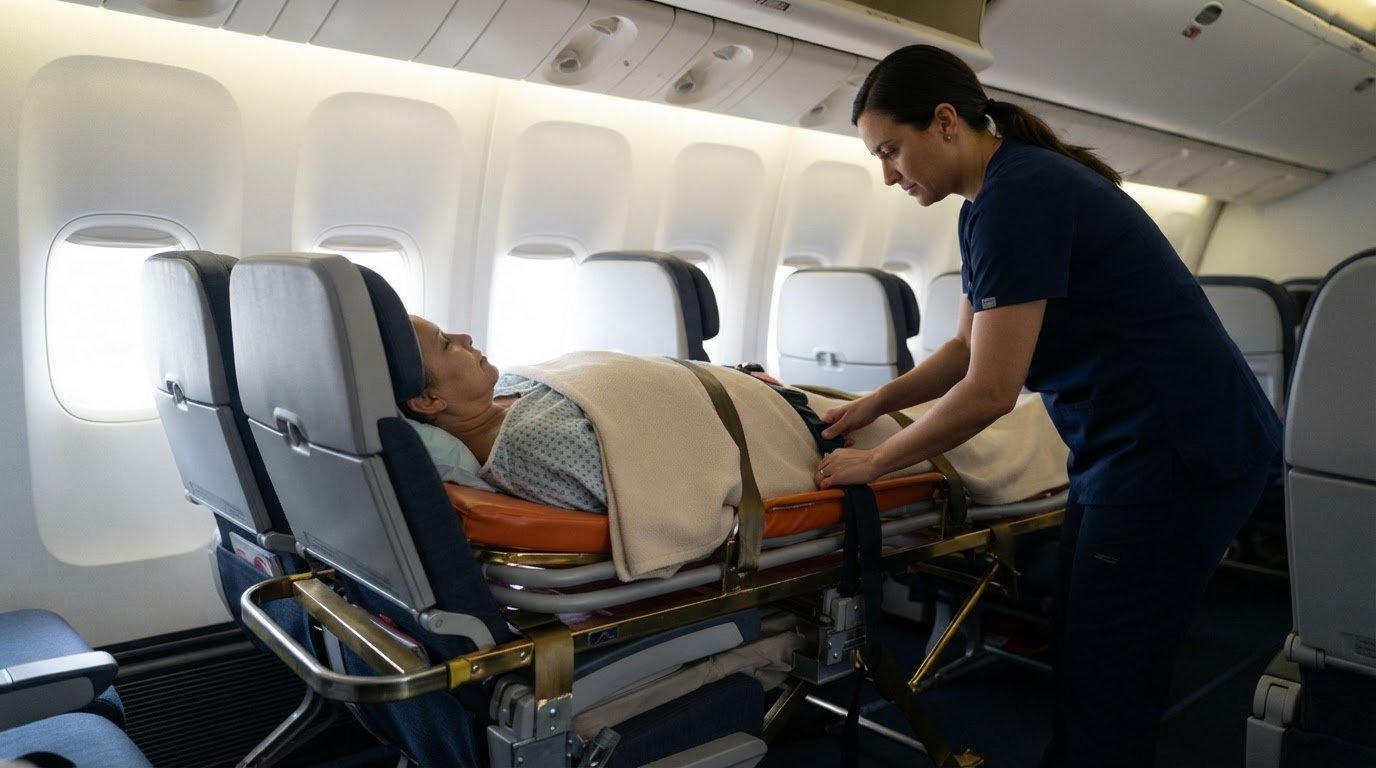
Oxygen-Dependent Patient Air Travel: An RN Escort's Approach
Patients who depend on supplemental oxygen can travel on commercial airlines, but the planning involved is more detailed than most families expect. Cabin pressure lowers the oxygen available to the body, and a patient who is stable on the ground may show symptoms during a flight. Safe oxygen dependent patient air travel depends on early physician input, accurate equipment planning, timely airline notification, and an escort who monitors the patient from the first boarding call to the final exit. This article describes how a registered nurse approaches each stage of that process.
Table of Contents
Quick Takeaways
Key Insight | Explanation |
|---|---|
Obtain physician clearance before any booking is confirmed | The treating physician determines whether in-flight oxygen is needed and whether a high-altitude simulation test is warranted. Booking first often forces a route or schedule change later. |
Confirm the flow rate on the medical certificate | The certificate should state the flow rate in liters per minute. The allowable range cited in published guidance is 0.5 to 6 liters per minute, so the prescribed rate must fall within it. |
Notify each airline separately | Some airlines may require notice 48 hours before departure and check-in at least one hour before the flight. Requirements can differ by carrier and by segment. |
Plan battery and oxygen supply for total elapsed time | Delays on the ground, during taxi, and at connections extend the time oxygen is required. Calculate supply from the patient's home to the destination, with a margin added. |
Request a window seat with adjacent escort seating | A window seat reduces the risk of tubing becoming tangled in the aisle, and an adjacent seat allows continuous monitoring. |
Match in-flight oxygen decisions to flow rate and activity | Patients using two liters at rest or three to four liters with activity will likely need oxygen during air travel. Patients using oxygen only at night or one to two liters with activity typically do not, according to published guidance, but the physician should confirm this. |
Physician Clearance Before Booking
Planning for an oxygen-dependent patient begins with the treating physician, not with the airline. Published clinical literature describes advising patients before air travel as a frequently overlooked but important role of the physician, particularly primary care providers and pulmonary specialists. In practice, an escort should request the physician's review before any reservation is treated as final, so that the itinerary is built on documented clinical advice rather than assumptions.
The physician's review answers two questions. The first is whether in-flight oxygen is needed at all. The second is what flow rate the patient requires at cabin altitude. Patients who use oxygen only at night or at low flow with activity may not need supplemental oxygen on a flight, while those using higher flows at rest or with activity usually do.

The Flow Rate Prescription
A flow rate that is adequate at sea level may be insufficient in a pressurized cabin. For this reason, the physician may consider a high-altitude simulation test, which mimics the atmospheric pressure of an airplane cabin. The result indicates how much oxygen the patient needs at altitude and whether a higher flow will be required during the flight.
Escorts should not assume that the home prescription will carry over unchanged. A patient who is comfortable at a given setting on the ground may need an adjusted setting once the aircraft is airborne. The physician's written instruction should specify the in-flight flow rate separately from the home rate.
The Medical Certificate
The medical certificate should state why oxygen is medically necessary and the flow rate per minute the patient needs. It should also confirm that the patient can physically and cognitively use the oxygen equipment and respond to warnings and alarms. Some airlines require their own form, so the escort should check each carrier's requirements before the certificate is finalized.
Pro tip: Ask the physician's office to list the in-flight flow rate on the certificate as a separate line. Confirm whether each airline requires its own form before the certificate is signed, since a revision after signing can delay the booking.
Cabin Altitude and Blood Oxygen
Commercial aircraft pressurize their cabins, but the pressure remains lower than at sea level. Published guidance notes that oxygen levels in pressurized cabins are about 25 percent lower than at sea level. Reduced oxygen pressure lowers the oxygen level in the blood, which is the central reason oxygen dependent patients require planning before departure.
Patients with pulmonary disease face a higher risk of serious complications during air travel. The clinical literature recommends a specific approach to risk stratification for these patients, rather than a single general standard. An escort should therefore treat the physician's assessment as the basis for every decision that follows, including the decision to travel at all.
Why Cabin Pressure Lowers Oxygen Levels
As altitude increases, the amount of oxygen available to breathe decreases. Symptoms commonly associated with high altitude include fatigue, shortness of breath, rapid breathing with activity, dizziness, rapid heartbeat, and headache. For patients with pulmonary hypertension, published guidance notes that high altitudes can worsen existing symptoms.
These effects are not limited to the aircraft. Destinations at higher elevation can produce similar symptoms after arrival, which means the oxygen plan should cover the destination as well as the flight.
Recognizing Early Symptoms
The escort's first task is to establish a baseline before departure. This includes resting breathing rate, skin color, the ability to speak in full sentences, and tolerance for walking from the gate to the seat. Changes that appear during boarding are often the earliest indication that the flow rate or delivery method needs adjustment.
In practice, escorts record the baseline in writing and compare it at intervals during the flight. A consistent pattern of change is more useful than a single reading, and any new or worsening symptom should be reported to the treating physician and the flight crew without delay.
Airline Notification and Documentation
Airlines set their own rules for passengers who use oxygen. Published guidance notes that some carriers may require notice 48 hours before departure and check-in at least one hour before the flight so that they can accommodate the patient's needs. An escort should treat these figures as points to confirm with each carrier, since requirements can vary between airlines and between segments of the same itinerary.
Notifying the airline is a separate step from booking the ticket. The escort should record the date and time of each notification, the name of the agent, and any reference number provided. This record is useful if the airline's file does not match the booking at the airport.
Notice Periods and Check-In Timing
Every segment of a journey may have its own requirements, including connecting flights operated by different carriers. The escort should build a single timeline that lists each airline's notice deadline and check-in window. Missing one deadline on a connecting segment can affect the entire itinerary.
Arriving early at the airport also provides time for security screening of medical equipment. Escorts should expect questions about the device, batteries, and the physician's certificate, and should have documentation ready in a single folder.
Seat Selection and Equipment Placement
Published guidance recommends booking a window seat when traveling with supplemental oxygen. A window seat reduces the chance that tubing or equipment will become tangled in the aisle, where passengers and cabin crew move frequently. The escort's seat should be adjacent to the patient so that monitoring is continuous during the flight.
Equipment should be stored where it does not obstruct the aisle or the patient's access to the call button. Cabin crew should be informed before takeoff of where the equipment is placed and how it will be secured during taxi, takeoff, and landing.
Equipment and Battery Planning
Equipment planning begins with duration. Published guidance advises patients to plan for delays and to pack enough battery power for the trip. Delays occur before pushback, during taxi, on the runway, and at connections, so the calculation should cover the full elapsed time from the patient's home to the destination, not only the scheduled flight time.
Battery calculations should be based on the prescribed flow rate, not the lowest setting the device can deliver. Escorts typically add a margin on top of the calculated requirement, which covers unexpected holding on the ground and any extended transfer between terminals. The margin should be written into the plan so that the family and receiving facility can see the same figures.

Calculating Battery Duration
The device manufacturer's specifications describe battery run time at each flow setting. An escort should confirm those figures for the exact device and setting, and should record the duration of each battery in the plan. Charging equipment, adapters, and spare batteries should be listed separately so they are not forgotten at check-in.
Pro tip: Pack all batteries and charging equipment in carry-on luggage, not checked baggage, and confirm the airline's current rules on battery carriage before departure.
Coordinating With the Oxygen Supplier
Published guidance recommends contacting the oxygen supplier early in the planning process. The supplier can confirm that the device and its accessories are suitable for the trip, arrange a supply at the destination, and provide written information on operating the equipment. For longer stays, the supplier can deliver equipment to the destination address rather than relying on local sourcing.
Escorts should share the supplier's contact details with the family, the receiving facility, and the treating physician. A single point of contact reduces delays if an equipment problem arises during a trip.
The RN Escort Role in Flight
The escort's role is distinct from the responsibilities of the flight crew. A registered nurse monitors respiratory status, equipment function, and comfort, and coordinates with cabin crew about the patient's needs. The RN does not replace the treating physician, and every decision made in flight should fall within the plan that the physician has documented.
Oxygen service requires consistent attention throughout the journey. Escorts check flow settings after each equipment change, confirm that alarms are audible, and watch for signs that the delivered oxygen is not meeting the patient's needs. Routine checks are more reliable than reactive checks, particularly during meals, restroom trips, and changes in cabin lighting or movement.
Reliable oxygen management on a commercial flight depends less on the size of the supply and more on a written plan that the patient, escort, and crew all understand and that is checked at every transition.
Monitoring From Boarding to Takeoff
The period from boarding to takeoff is when many equipment problems first appear. Tubing may be kinked by a seat, batteries may lose charge during a long wait, or the patient may feel short of breath after walking the length of the aircraft. Escorts should confirm the device, the flow setting, and the patient's comfort before the doors close.
Once airborne, the escort should review the baseline assessment and note any changes. Any change that is new, persistent, or worsening should be escalated to the physician on call, and the flight crew should be informed so that they can assist if needed.
Safety Rules for Oxygen Onboard
Oxygen supports combustion, so equipment must be handled with care in the cabin. Smoking and open flames are prohibited near oxygen, and cylinders or equipment should be secured for takeoff and landing as the crew directs. Escorts should explain these rules to the patient and family before the flight begins, not during it.
Equipment should never be used in a way that exceeds the prescribed flow, and no adjustments should be made without the physician's instruction. Escorts document each adjustment in the flight record so that the receiving team has a complete account of the patient's oxygen use.
Delays, Connections, and Ground Transfers
Connections multiply the number of points at which an oxygen plan can fail. Each gate change, security checkpoint, and airport transfer requires the equipment to be checked and the flow rate confirmed. Published guidance advises patients to plan for delays, and that advice applies with particular force to itineraries that include more than one connection.
An escort should prepare a written schedule that lists every airport, gate change, and expected transfer time. Where a connection is short, the escort should identify whether the equipment can be moved quickly and whether a wheelchair or other assistance has been arranged with the airline.
Planning for Connections
Connecting itineraries also raise the risk of missed flights. If a delay causes a missed connection, the escort should have a second plan that covers the oxygen supply, the rebooking process, and the notification of the physician and receiving facility. Having the plan prepared before departure avoids decisions made under pressure at the gate.
Airports can be large, and walking distances between gates can be long. The escort should confirm mobility assistance in advance, since a patient who is short of breath after a long walk may need a rest period before boarding.
Ground Transfers at Higher Elevation
Oxygen planning does not end when the aircraft lands. Published guidance notes that travel by car, train, or bus at higher elevations may require more supplemental oxygen than usual, particularly above 4,000 to 5,000 feet. The same guidance observes that a gradual change in elevation may not be noticeable until the traveler gets out of the vehicle and moves around.
Pro tip: Include the ground transfer flow rate and any change in elevation on the same written plan as the flight, so that the family, driver, and receiving facility work from identical instructions.
Comparing Oxygen Arrangements
Patients who travel on commercial flights generally use one of a small number of oxygen arrangements. Each has different requirements for weight, battery life, stowage, and airline acceptance. The right choice depends on the prescribed flow rate, the length of the journey, and the availability of supply at the destination.

Choosing Between Device Types
The table below compares three common arrangements from a planning perspective. The comparison is intended to support discussion with the physician, supplier, and airline, not to replace their advice.
Oxygen Arrangement | Planning Consideration | Practical Fit |
|---|---|---|
Patient's own portable oxygen concentrator | Depends on battery capacity at the prescribed setting, and requires confirmation that the airline accepts the device and its batteries before booking. | Suited to patients with a stable prescription within the device's range who can carry their own equipment through the airport. |
Compressed oxygen cylinders | Adds weight and volume, requires stowage that meets crew instructions, and demands a quantity sufficient for the full journey plus a margin. | Suited to patients who need higher flows or a reliable backup source, provided the supplier confirms the cylinder arrangement for the airline. |
Destination supply arranged by the oxygen supplier | Reduces the quantity carried on the aircraft, but requires confirmed delivery and a tested handover at arrival. | Suited to longer stays and to patients whose flights are short relative to the stay, with the supplier's written confirmation in the plan. |
In practice, many plans combine two arrangements. A portable device may be used on the aircraft and in the airport, while a supplier arranges oxygen at the destination. Each component should be confirmed with the relevant party, and the combined plan should be reviewed by the physician before travel.
Common Mistakes to Avoid
Several errors recur in oxygen planning for commercial flights. Most are preventable with early coordination, and each can delay a journey or create a safety concern on the day of travel. Escorts and families benefit from reviewing these points before the booking is confirmed.
The most frequent error is relying on the home flow rate without a physician's review of cabin conditions. A second common error is booking the flight before the physician has documented the in-flight requirement. Both errors often surface at check-in, when the options are limited.
Assuming the Home Prescription Applies in Flight
A prescription written for daily use at home does not always describe the needs at cabin altitude. Patients who assume their home setting will be sufficient may find that symptoms develop after takeoff. The physician should confirm the in-flight rate in writing, and the escort should verify that the equipment can deliver it.
Battery planning is a related error. Escorts sometimes calculate supply for the scheduled flight time only, which leaves no margin for delays on the ground or at connections.
Late Notification and Missing Paperwork
Late notification to the airline is a frequent cause of difficulties at check-in. Some carriers may require notice 48 hours before departure, and a notification made at the airport may not be recorded in time. Paperwork gaps create similar problems, particularly when the medical certificate does not match the airline's own form.
Seat assignment is also commonly overlooked. A seat that is not adjacent to the escort or that sits in the aisle can make monitoring and equipment management more difficult throughout the flight.
Frequently Asked Questions
Can an oxygen dependent patient fly on a commercial airline?
Many oxygen dependent patients can fly on commercial airlines when a treating physician has assessed the risk and documented the in-flight oxygen requirement. The airline must also be notified and must accept the equipment. Patients with significant pulmonary disease benefit from a formal preflight assessment before the booking is finalized.
Do all patients who use home oxygen need oxygen during a flight?
No. Published guidance indicates that patients using oxygen only at night or at low flow with activity typically do not need supplemental oxygen on a flight, while those using higher flows at rest or with activity likely do. The physician should make the final determination for each patient.
How far in advance should an airline be notified?
Published guidance notes that some airlines may require notice 48 hours before departure and check-in at least one hour before the flight. Requirements vary by carrier, so the escort should confirm the deadline for every airline on the itinerary.
What flow rate range do airlines accept for supplemental oxygen?
The allowable range cited in published guidance is 0.5 to 6 liters per minute. The prescribed flow rate should appear on the medical certificate and should fall within the range accepted by the airline, which the escort should confirm before travel.
What does a registered nurse escort do on a commercial flight?
A registered nurse escort monitors respiratory status, equipment function, and comfort throughout the journey, and coordinates with the flight crew about the patient's needs. The escort works within the plan documented by the treating physician and does not replace the physician's role.
How does an RN escort on a commercial flight differ from a dedicated air ambulance?
A dedicated air ambulance service uses an aircraft configured for medical transport. An RN escort on a scheduled commercial flight provides nursing oversight for patients who can travel on a commercial airline with appropriate planning, and it is generally offered at a lower cost than a dedicated aircraft.
We welcome feedback from families, hospital discharge planners, and case managers about how oxygen requirements were handled on their own journeys, and we invite you to share your experience.