Transporting a Patient After a Recent Heart Attack by Air
A successful angioplasty doesn’t automatically mean a patient is ready to fly. After recovery, transporting a patient with a recent heart attack internationally may be possible within 48-72 hours, but readiness depends on clinical stability and the treating cardiologist’s assessment. No ongoing chest pain or arrhythmia, stable vital signs, and no need for acute intervention all matter.
It’s understandable to focus first on when travel can happen. But the flight plan also depends on whether the airline approves the patient to fly and whether oxygen or medical support is needed onboard. This guide explains how medical readiness, escort arrangements, monitoring, oxygen approval, and insurance shape the decision. You’ll also learn what medical information helps establish the plan and how commercial-flight transport differs from other transport options, so you can discuss the next steps with greater clarity and confidence.
Table of Contents
1. Cardiac monitoring, oxygen, and onboard equipment
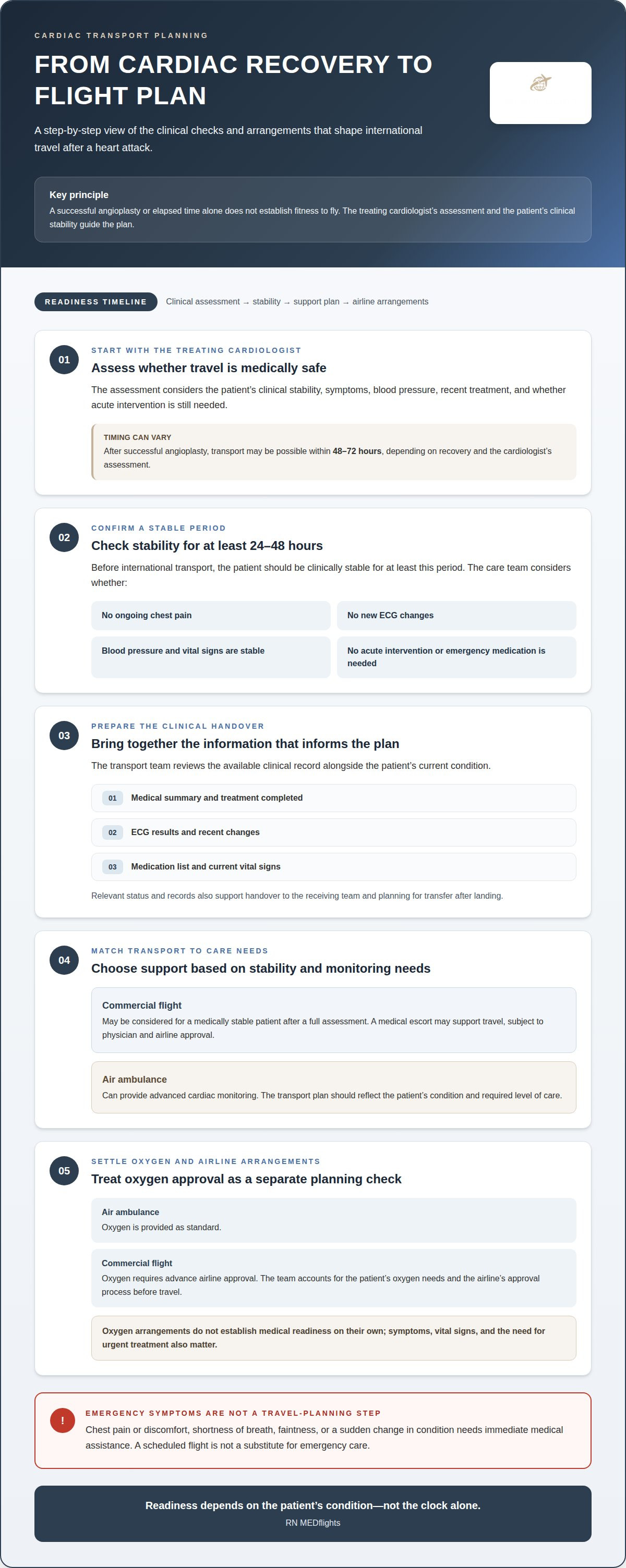
Medical precautions start with a cardiologist’s assessment of the patient’s condition and recent treatment. For transporting a patient with a recent heart attack, the treating cardiologist must confirm international travel is medically safe. The assessment considers clinical stability, symptoms, blood pressure, and whether acute intervention remains necessary. A successful angioplasty may allow transport within 48-72 hours, depending on recovery and the cardiologist’s assessment.
Timing alone doesn’t establish readiness. Before international transport, the patient should be clinically stable for at least 24-48 hours. Stability includes no ongoing chest pain, no new ECG changes, stable blood pressure, and no need for acute interventions. Vital signs should also remain stable without emergency medication. These criteria help the care team determine whether a commercial flight with an escort is appropriate.
Onboard monitoring should match the patient’s condition and care plan. The medical team reviews the cardiology assessment and ECG findings, then identifies what observation and support are needed during the journey. An air ambulance can provide advanced cardiac monitoring, while commercial-flight arrangements depend on the patient’s stability and airline approval. A medical escort is an option for a stable patient after a full assessment.
Oxygen planning is a separate part of the transport plan. Air ambulances provide oxygen as standard, while oxygen on a commercial flight requires advance approval. The team accounts for the patient’s oxygen needs and the flight’s approval process before travel. Oxygen does not determine medical readiness by itself; the cardiologist’s assessment also considers symptoms, vital signs, and the need for urgent treatment.
Families should recognize signs that need immediate medical assistance rather than planned transport. Possible emergency cardiac symptoms include chest pain or discomfort, shortness of breath, faintness, or a sudden change in the patient’s condition. If these occur, seek immediate medical assistance. A scheduled flight is not a substitute for emergency care, and a patient with ongoing chest pain or unstable vital signs isn’t ready for routine travel.
Medical transport planning starts with the patient’s condition and a physician’s assessment of fitness to fly. The planned transport must suit the patient’s needs and the airline’s requirements. For a medically stable patient cleared by a physician, an escorted commercial flight may be considered. If the patient is unstable or needs urgent treatment, seek immediate medical assistance rather than arranging routine passenger travel.
2. What medical information is required prior to transport?
A clear clinical record and destination plan support a safe handover. The team reviews the available medical summary, ECG results, medication list, and current vital signs. These records describe the diagnosis, treatment, recent changes, and support needs. The medication list, for example, helps the receiving team understand the patient’s current care. The medical summary also provides context for planning travel after discharge.
If a heart attack may be happening now, call 911 for emergency assistance, not scheduled transport. New chest pain, shortness of breath, faintness, or a sudden decline needs urgent assessment. A scheduled journey is for a patient whose immediate emergency has been treated and whose care team has assessed travel readiness.
To assess car, plane, or ambulance travel, professionals review the records alongside the patient’s current condition. They consider symptoms, ECG findings, vital signs, treatment completed, and whether acute intervention is still needed. The selected mode must match the required level of monitoring and care. A car may suit a stable patient traveling a short distance, while longer or more complex journeys may need professional medical support. An ambulance provides continuous monitoring, which can matter during short- or medium-distance repatriation.
Ground transport after landing is part of the same clinical plan, not an afterthought. The team coordinates the transfer from the airport to the receiving facility and shares relevant information during the handover. The receiving team needs the patient’s current status, medication details, and recent ECG results. A ground ambulance can support a patient who needs monitoring during this leg. Route length, patient mobility, and the destination’s receiving arrangements shape the transfer plan.
The cost of transporting a patient after a heart attack depends on the transport type and the patient’s needs. RN MEDflights provides a quote based on the journey and required arrangements. A private car is not a substitute for a medical escort when professional supervision is needed. A physician’s assessment helps establish whether the patient is medically stable and cleared to fly.
For a planned transfer, the records help connect hospital care with the journey and arrival. A coordinated handoff can keep the receiving facility informed and support ground transfer planning. This is especially useful when a patient needs an ambulance after landing or across a longer ground route. The plan should account for the patient’s condition throughout each stage, from departure to arrival.
3. Insurance coverage and assistance
Insurance review is a separate part of planning international medical transport after a heart attack. Some policies may cover medically necessary repatriation, depending on their terms and documentation requirements. Reimbursement is not automatic, and coverage may depend on how the policy defines medical necessity. The proposed destination, transport method, and patient’s assessed needs help explain the plan.
Start by reviewing the policy wording. Check whether it covers medical repatriation, what documentation it requires, and how reimbursement is handled. Coverage for treatment and transport may be addressed separately. A policy may also specify what information is needed to assess medical necessity. Reviewing these terms early helps families understand the insurer’s process before travel plans are finalized.
Documentation connects the patient’s condition to the proposed journey. A medical summary describes the recent heart attack, treatment, and current assessment. ECG results, the medication list, and current vital signs add context to the clinical record. Together, these materials help the team plan appropriate support and prepare a clear handover.
Keep the transport plan consistent with the medical record. For example, if the cardiology summary describes a need for monitoring, the proposed transport arrangement should reflect that need. If the patient is clinically stable, the record should still explain the treating team’s assessment. Consistent details help the insurer review the request and help the receiving facility understand the patient’s care.
Transport costs depend on the case rather than a standard rate. RN MEDflights provides a quote based on the transport type and the patient’s needs. A ground ambulance for one leg and a nurse-escorted commercial flight for another involve different arrangements. The patient’s condition and the bed-to-bed plan also shape the quote. These factors help explain why costs vary.
Insurance assistance works best when medical planning and documentation stay aligned. The transport team can coordinate the clinical summary, ECG results, medication list, vital signs, and journey details into a coherent plan. Families can use the policy’s wording to understand which documents are relevant to reimbursement. Keep records of the transport plan and the medical information supporting it, so the insurer has the details needed for its review.
International Medical Repatriation may be appropriate when a patient needs a planned return journey after treatment abroad. The arrangement should reflect the patient’s clinical status, required support, distance, and destination. Insurance terms and documentation remain part of the planning process. Separating the clinical decision from the coverage review helps clarify two different questions: what transport the patient needs, and what the policy may reimburse.
4. Medical escort on commercial flights
A medical escort on a commercial flight is an option for a stable patient after a full assessment. The patient should have no active chest pain or arrhythmia. The treating cardiologist’s assessment helps establish whether passenger travel is appropriate. Airline approval is also required. A commercial flight is not suitable when the patient needs urgent intervention or has unstable symptoms.
Before planning the journey, the medical team reviews the patient’s current condition and treatment history. A cardiology summary, ECG results, medication list, and current vital signs help inform that review. The team considers whether symptoms have changed and whether emergency medication or acute treatment remains necessary. This assessment connects the patient’s medical needs with the demands of the planned flight.
Flight preparation includes coordinating airline medical clearance. Airlines may require medical forms and approval from their medical department for passengers who recently had a heart attack. The medical team organizes relevant information for review and coordinates any required support. Airline approval should be secured before the travel arrangements are considered final, especially when oxygen is needed.
The escort supports the patient during travel in line with the agreed care plan. The escort can observe the patient and communicate relevant changes. The plan should clarify the patient’s needs, flight arrangements, and how care connects with ground transfers. RN MEDflights coordinates bed-to-bed travel, including airline logistics and ground transport to and from the airports.
Oxygen needs require separate planning. Oxygen on a commercial flight requires advance airline approval. The medical team considers the patient’s oxygen needs and coordinates the airline’s approval process before departure. Approval for an escort does not automatically mean oxygen is approved. Each part of the plan must match the patient’s assessed needs and the airline’s decision.
Coordination also includes the transfer to and from the airport. The patient’s mobility, journey length, and need for monitoring help determine whether ground ambulance support is appropriate. The receiving facility should receive relevant medical information during handover. This continuity matters because the commercial flight is only one part of the journey, not the end of the patient’s care.
If chest pain, arrhythmia, or unstable vital signs arise before departure, the planned commercial journey should be reconsidered. A patient who remains unstable after a heart attack should travel only by air ambulance with a critical-care medical team. That is a different transport pathway from an escorted commercial flight, and the patient’s condition determines which level of care is needed.
5. Airline approval and oxygen arrangements
A physician’s clearance and airline approval are separate decisions. The physician assesses whether the patient is medically ready to travel. The airline’s medical department may review forms before approving a passenger who recently had a heart attack. A favorable medical assessment does not replace the airline’s approval process. Both decisions must align before a commercial flight can be planned.
Oxygen adds another approval step. Oxygen on a commercial flight requires advance approval from the airline. The clinical plan should identify whether the patient needs oxygen and how that affects the flight arrangements. Approval for an escort does not automatically approve oxygen. The medical team coordinates the requests so the airline can review the patient’s needs.
A clear sequence helps keep the arrangements aligned:
The treating cardiologist assesses the patient’s readiness and provides relevant medical information.
The medical team prepares the airline’s required clearance forms for review.
The airline’s medical department reviews the request, including any oxygen requirement.
The travel plan proceeds only when the medical assessment and airline approval support the proposed flight.
The supporting records can include the cardiology summary, ECG results, medication list, and current vital signs. These details help describe the patient’s treatment and current condition. For example, current vital signs and ECG results provide clinical context for the airline’s review. The team also accounts for the patient’s care plan, so the requested arrangements reflect actual medical needs rather than assumptions.
Timing matters because approval must be arranged in advance, especially for oxygen. The medical team coordinates the forms and the oxygen request before travel rather than treating them as airport-day tasks. If the patient’s symptoms or condition change after the records are prepared, the clinical assessment may need to be updated. New chest pain or arrhythmia also changes whether commercial travel is appropriate.
Commercial travel is not appropriate for every patient. A commercial medical escort is for a medically stable patient cleared by a physician to fly. Airline approval and any required oxygen arrangements must also be in place. The central takeaway is straightforward: the patient’s medical assessment, airline clearance, and travel arrangements must fit one plan.
For help coordinating the airline medical review and escort arrangements, arrange commercial-flight medical escort planning.
RN MEDflights: Bed-to-Bed Medical Transport
RN MEDflights coordinates Bed-to-Bed Medical Transport for patients who need a planned journey between care facilities after a heart attack. This can connect hospital discharge, ground transfers, and travel arrangements while keeping the patient’s medical needs central to the plan.
For a medically stable patient cleared by a physician to fly, Commercial Airline Medical Escort may be appropriate. RN MEDflights coordinates ground transfers as part of its bed-to-bed service. The right arrangement depends on the patient’s assessment, destination, and required support. These services are for planned medical transport, not emergency care.
If you’re arranging travel for a patient after a heart attack, contact RN MEDflights to discuss a bed-to-bed transport plan.
Plan the next step with confidence
When transporting a patient with a recent heart attack, the next step is to turn the medical assessment into a coordinated journey. The treating physician’s guidance helps clarify the patient’s needs, while the travel plan connects pickup, ground transport, flight, and arrival at the receiving bed. A clear handover gives the receiving care team relevant information to continue care.
RN MEDflights offers Commercial Airline Medical Escort, International Medical Repatriation, and Domestic Medical Relocation. These services address different journeys, from supported commercial travel to planned relocation. The appropriate arrangement depends on the patient’s condition, destination, and required support.
For help planning a suitable medical journey, contact RN MEDflights. Sharing the patient’s destination and clinical transport needs can help begin a focused discussion about the next steps. A clear plan can make a difficult transition more manageable for both the patient and family.
Frequently Asked Questions
Can a patient fly after angioplasty (PCI)?
Yes, a patient may be able to fly after angioplasty once medically stable and cleared for travel. After successful angioplasty, international transport may be possible within 48-72 hours, depending on recovery and the treating cardiologist’s assessment. The patient should have no ongoing chest pain, new ECG changes, unstable blood pressure, or need for acute intervention. Airline approval is a separate requirement for commercial flights.
Can family members accompany the patient?
A family member may travel alongside the patient, separately from the medical escort. The escort provides professional supervision, while a relative can offer personal support. Seating, airline approval, and the patient’s care arrangements shape the plan. Clarify who will accompany the patient and who will coordinate updates with the receiving facility.
Do airlines allow passengers who recently had a heart attack?
An airline may approve travel after a recent heart attack, subject to medical review. The airline may require medical clearance forms and review them through its medical department. The patient’s condition, planned support, and any oxygen request are relevant to the arrangements. A physician’s clearance informs the decision but does not replace the airline’s own approval.
How fast can transport be arranged?
Timing depends on medical clearance and how quickly the travel arrangements can be coordinated. For a commercial flight, the plan must account for airline review, any oxygen approval, flight arrangements, and ground transfers. A change in symptoms can affect readiness and require reassessment. Sharing the patient’s current condition, location, destination, and medical records helps organize the planning process.
How soon after a heart attack can someone fly?
There is no single safe interval for every patient. After successful angioplasty, international travel may be possible within 48-72 hours, depending on recovery and the treating cardiologist’s assessment. The patient should be clinically stable for at least 24-48 hours before international transport. Readiness also depends on symptoms, ECG findings, blood pressure, and whether acute treatment remains necessary.
Is flying dangerous for someone with recent cardiac symptoms?
New or worsening symptoms require immediate medical assistance, not a scheduled flight. If the patient’s condition changes before departure, pause travel planning and seek urgent assessment. Commercial travel is considered only for a medically stable patient cleared by a physician to fly, with arrangements suited to the patient’s needs.
Is oxygen available during international transport?
Oxygen arrangements depend on the transport method. Air ambulances provide oxygen as standard, while oxygen on a commercial flight requires advance airline approval. The approval process should be coordinated before departure and tied to the patient’s assessed needs. A medical escort and an oxygen request are separate elements of planning, so approval for one should not be treated as approval for the other.
What medical information is required prior to transport?
Transport planning typically uses a cardiology summary, ECG results, medication list, and current vital signs. These records give the medical team a view of the diagnosis, recent findings, current treatment, and the patient’s status. For example, the ECG and vital signs help explain the current clinical picture. The information also supports airline review and helps the receiving facility prepare for handover.